


Norwegian Armchair Travel: The Mills
By now in our Norwegian Mini Course, you've met the sheep. Now it's time to meet the mills that spin their wool into the yarn you know and love. Norway is home to a handful of extraordinary yarn producers, each with its own character, history, and approach to fiber. In this installment, we're introducing you to the Norwegian brands in our collection: Rauma, Sandnes Garn, and Hillesvåg Ullvarefabrikk. Pull up a chair.

Rauma - From Wool to Gold

Rauma Ullvarefabrikk has been spinning yarn since 1927 in the town of Åndalsnes, a dramatic spot in the Romsdal region of western Norway, hemmed in by steep mountains and a winding fjord. The mill survived a devastating bombing in World War II and was immediately rebuilt, a resilience that feels fitting for a company whose yarn is built to last. Today, Rauma remains one of the few Norwegian mills producing yarn spun and finished entirely in Norway, which is perhaps why their motto translates so directly: "from wool to gold" — fra ull til gull in Norwegian, where the rhyme lands with a satisfying ring.
Rauma is also well-known as a pattern publisher, and we carry some of their hefte booklets here at The Woolly Thistle, hefte simply meaning "booklet" in Norwegian. These small pattern collections have been a cornerstone of traditional Nordic colorwork for decades, with designs that draw directly from the heritage of the region: Selbu roses, geometric patterning, and classic silhouettes.
 |
 |
| At Rauma, newly washed wool waits in cloud-like piles, ready for carding and spinning. | Carded wool moves steadily through the machinery at Rauma, fibers aligned and ready for spinning. |
Rauma yarns we carry:
Finullgarn

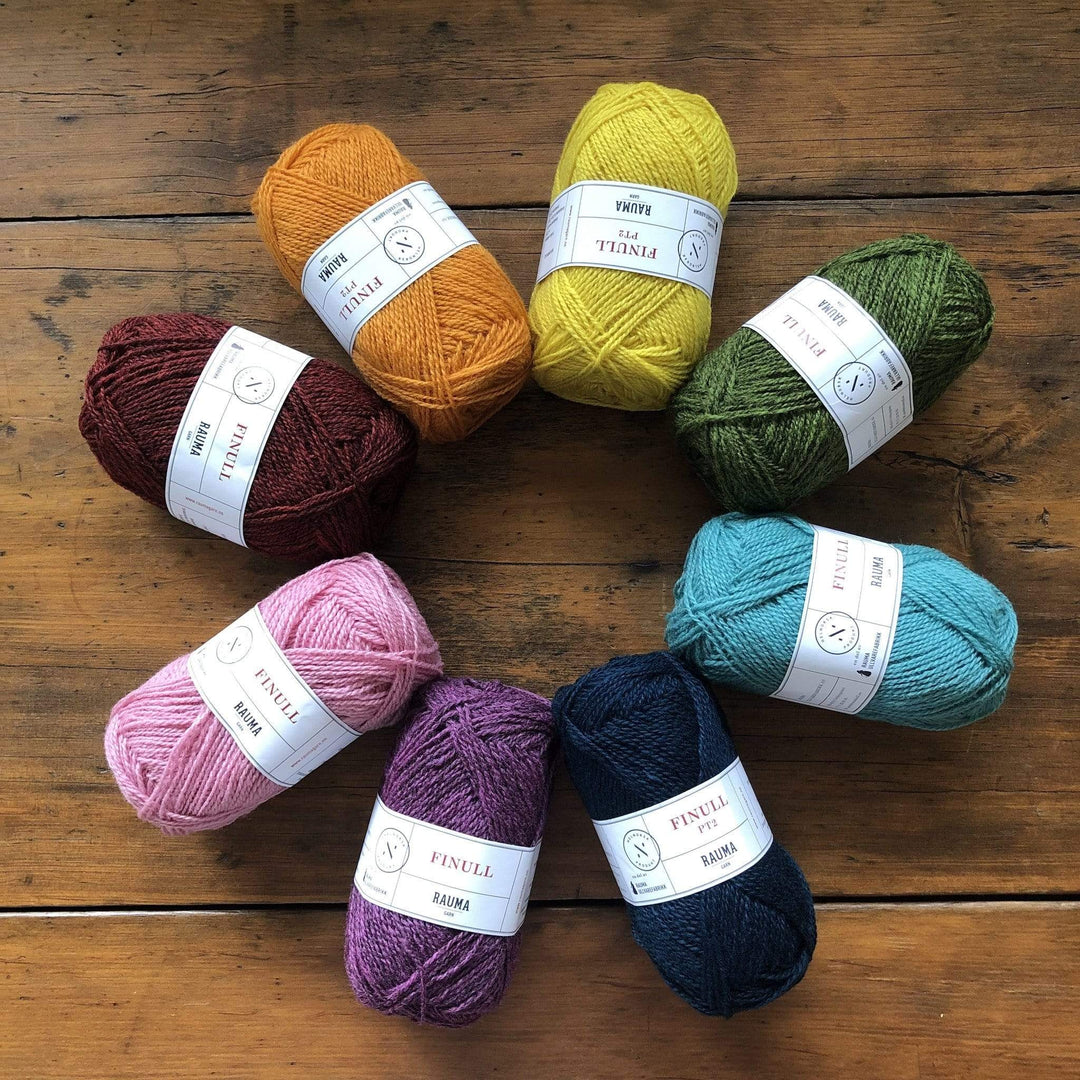
Finullgarn is Rauma's flagship yarn. A 2-ply, sport-weight yarn spun from 100% Norwegian wool, Finullgarn (which translates to "fine wool yarn") is one of the most reliably excellent colorwork yarns you'll find. It's woolen-spun, so it has a loft and airiness that belies its strength. Colors pop, stitches hold their definition, and finished garments develop a beautiful, lived-in softness after washing. Finullgarn is also a natural for felting.
Strikkegarn

Step up one weight and you're at Strikkegarn, a 3-ply DK. Made from the same Norwegian wool as Finullgarn, the extra ply gives it a rounder, bouncier character. It knits up with a satisfying firmness that calls to mind traditional ski sweaters and Selbu mittens. Ideal for colorwork and textured stitch work alike.
Vams

Vams is Rauma's worsted/aran-weight option, also 100% Norwegian wool, but spun more loosely than the lighter yarns in the line. Vams is a lofty 2-ply with surprising squish. It's the one for cozy sweaters with a soft halo, and Rauma also recommends it for felting projects.
Fivel

Rauma's newest addition and their softest wool yarn is Fivel. A 2-ply, lightly spun worsted weight, Fivel is made from the finest fibers of Norwegian sheep (a blend of Norwegian breeds). The relaxed spin creates garments that feel airy rather than heavy, and items only get softer after washing. It's especially well-suited to braided textures and structural stitches, as well as colorwork. Rauma's Pattern Book 425 features several lovely Fivel designs.
Plum

A departure from the all-wool lineup: Plum is a lace-weight mohair blend of 70% super kid mohair and 30% polyamide. Knit alone for a delicate halo fabric, held double for fluffier results, or paired with another yarn to add a soft shimmer. Plum knits up beautifully in wraps, shawls, and layered garments.
Vandre

Named for the Norwegian word for hiking, Vandre is Rauma's sock and utility yarn. It's 100% Norwegian wool, with 50% of the blend coming from the Spælsau breed, one of Norway's oldest sheep, whose long outer fibers give the yarn exceptional durability. Vandre is a sport-weight yarn well-suited to socks, hiking wear, and anything that needs to hold up to hard use.
Sandnes Garn - Home of a Norwegian Icon

Sandnes Garn has been producing yarn since 1888, making it one of the oldest mills in Norway. The factory is still located in Sandnes, a city on the southwestern coast near Stavanger, and still privately owned. Around 14 million balls of yarn leave the factory each year, traveling to knitters across Norway and around the world.
Sandnes has a strong design identity alongside its production. Their most famous contribution to knitting history is probably the Marius sweater, which they have held the rights to since the 1950's. By some estimates over five million copies have been sold. It remains their best-selling design to this day!
For a deep dive into Sandnes Garn's history visit our blog Built to Last: The Story Behind Sandnes Garn if you'd like to go deeper — but here's an introduction to the two yarns we carry:
 |
 |
| Freshly dyed at Sandnes Garn, the wool is rich with color and ready to be spun into yarn. | At Sandnes Garn, newly spun yarn is wound into skeins, ready to make its way to you. |
Sandnes Garn yarns we carry:
Peer Gynt

Named for Henrik Ibsen's legendary dramatic character, Peer Gynt is Sandnes Garn's oldest yarn, on the market continuously since 1938. It's a DK-weight, 100% Norwegian wool — round, plied, and built for the long haul. The structure makes it a natural for traditional kofte sweaters, where the yarn's body helps the colorwork pattern read clearly. It's also a reliable choice for children's garments and anything that needs to hold its shape over years of wear.
Sisu
 Sisu is a fingering-weight yarn with a straightforward purpose: to be the most useful sock and utility yarn in your stash. Sisu is an 80% wool, 20% nylon blend, superwash treated for machine washability. The nylon reinforcement makes it ideal for socks and hard-wearing children's clothes; the wool keeps it soft enough for cowls, mittens, and layering pieces. Its tight twist gives cables and colorwork excellent definition. Sisu has been a favorite in Norway for kofte knitting since the early 1980s.
Line

Line is something a little different in the Sandnes collection: a plant-based yarn for spring and summer knitting. The blend of 53% cotton, 33% viscose, and 14% linen gives it a drape and softness you won't find in the wool yarns, with a faint linen texture and a subtle sheen from the viscose. It's a worsted-weight yarn that works beautifully in tees, camisoles, and lightweight cardigans, and it's machine washable. Sandnes publishes dedicated summer pattern collections designed specifically for Line.
Hillesvåg - Rare Breeds, Real Craft

Hillesvåg Ullvarefabrikk has been spinning yarn in the village of Hjelmås, north of Bergen, since 1898. The mill sits on the shores of the Osterfjord, and it's been in the same family for four generations. Some of the equipment still in use dates to 1905. Hillesvåg is part of the European Économusée network, an organization dedicated to preserving and sharing traditional craft knowledge — which tells you something about how they approach their work.
The mill uses traditional woolen carding throughout production: large cylinders pull Norwegian wool through thousands of fine needles, producing the airy, lofty fiber webs characteristic of their yarn. Every hank is hand-tied after winding and hand-twisted after dyeing. It's slower than industrial methods, and Hillesvåg maintains these techniques because the results are worth it.
We have a dedicated blog post about Hillesvåg if you'd like to go deeper — but here's an introduction to the two yarns we carry:
 |
 |
| At Hillesvåg, machinery like this carder has been in use for over a century, continuing to turn out yarn with remarkable consistency. | Hand-tying each hank at Hillesvåg continues a long-held practice, where skilled hands finish what the machines begin. |
The Hillesvåg yarns we carry:
Sølje

Sølje is a 2-ply fingering-weight yarn spun from 100% Norwegian Pelssau wool. The Pelssau (also called Norwegian Pelt Sheep or Norwegian Fur Sheep) is a rare breed — a cross between Gotland and the old Norwegian Spælsau — with a naturally grey, curly fleece. Hillesvåg is the only Norwegian mill still spinning Pelssau wool. Because the fleece contains both light and dark fibers, every dyed colorway carries an inherent depth: reds warm up, blues gain richness, and even neutrals have tonal complexity. Sølje is a fingering-weight yarn that shines in stranded colorwork and traditional Scandinavian garments, and it develops a beautiful halo after washing.
Luna

Luna is Hillesvåg's DK/worsted-weight lambswool yarn, spun from the finest fibers (C1 Fine, 28 microns) of Norwegian White Sheep (Norsk Kvit Sau). This very specific fiber selection produces a yarn that is lighter, softer, and airier than you might expect from worsted-weight wool — all dyed with GOTS-certified, biodegradable dyes. Luna is a go-to for sweaters, cardigans, and everyday garments where you want the warmth and resilience of Norwegian wool with a notably soft hand.
From Mill to Needles
From the mountain mills of Romsdal to a family workshop north of Bergen, these producers share something beyond geography: a commitment to fiber that lasts, yarn that improves with wear, and traditions worth keeping. Now that you know the mills and the yarns, there's only one thing left — the designs that bring it all to life.
Join us in the next installment of the Norwegian Mini Course, where we'll explore the patterns that have made Norwegian knitting famous the world over.
While you wait, take a virtual tour of Rauma Garn!
11 comments
Back to The Woolly Thistle




I must say this has been a wonderful journey, most enjoyable and the perfect learning experience. It’s all. beginning to come together, I am looking forward to knitting with some of this beautiful yarn! Very well done. I feel the information has been shared logically and the format builds one “stop” upon the next. Very well organized and a delight to read. Thank you💕
Thank you for this series. It’s so interesting to learn about the sheep and yarns and these great mills. I was so excited to buy some Hillesvag yarn I found at a shop Wisconsin today. It means so much to know its history.
Returned from Norway a week ago and of course bought yarn! Wish I had read this before the trip, as I would have focused on the mills, etc. Thank you for this. A tour focused on wool & knitting would be excellent!
That’s it. I need to go to Norway now. I am loving this.
Thank you so much for this series!! I have always been curious about Norwegian wool/yarn as my grandparents were from Norway. I have never had a chance to visit(maybe someday), but I enjoyed this armchair visit so much.
Leave a comment