


Armchair Travels: Spain & Portugal - Designs, Techniques & Traditions
Across the four stops we've taken so far, we have met the land, the sheep, the wool, and the people who turn that wool into yarn. Today we close the circle. We meet the knitters, the technique they pass down, the heritage cloth that has clothed shepherds for centuries, and the modern designers carrying the work forward.
Iberia's knitting tradition has its own distinctive shape. The peninsula's gift to the global craft is not a single iconic motif but something quieter and more enduring: a way of holding the yarn, a small library of working garments built around wool, and a community of designers who let the fiber lead the way.
The Portuguese Way of Knitting

Across the Iberian Peninsula, knitting has been part of rural life for centuries, particularly among women working at home. The Catalan painter Dionís Baixeras captured one such moment in 1888, showing a Spanish woman absorbed in her knitting outdoors. Spanish knitting was largely practical, focused on everyday garments knit from local wool. Like much of Iberian wool culture, it was preserved through daily use rather than through formal documentation.
Portugal, by contrast, preserved more than the act of knitting. It preserved a distinctive technique.
If you have ever watched a Portuguese knitter at work, you may have noticed something unusual right away. The yarn does not run through the fingers in the familiar English or Continental fashion. It loops around the back of the neck, or threads through a small pin fastened at the shoulder of the knitter's shirt. From there, the working yarn falls across the chest and into the work, tensioned not by hand but by gravity and the simple geometry of the body.
The technique looks unfamiliar at first glance. Once mastered, however, it is remarkably easy on the hands. The purl stitch becomes the natural, dominant motion, accomplished with a small flick of the left thumb rather than the wrap-and-pull of English style. Many knitters who have developed wrist or thumb strain over the years report that Portuguese knitting has let them return to the craft they love. This is one of the reasons it has steadily found new students around the world.

The history runs deeper than Portugal itself. Knitting historians trace the technique to the Arab world of the early medieval period, where some of the earliest true knitting yet discovered comes from places like Coptic Egypt. The technique traveled through the Mediterranean and reached the Iberian Peninsula during the Umayyad expansion, around the eighth century. It spread north into Greece, Bulgaria, and Turkey, where versions of it persist today, and west into Iberia, where Portuguese and Spanish navigators eventually carried it across the Atlantic. Variations of the same neck-tensioned, purl-dominant style are still used by knitters in Peru, Bolivia, and Brazil. The technique has many names. Turkish knitting, Andean knitting, Incan knitting, "around the neck" knitting, and Portuguese knitting all describe essentially the same family of methods.
What makes Portugal the keeper of this tradition is partly geography and partly persistence. The technique stayed in continuous use in Portuguese rural communities long after it fell out of fashion elsewhere in Europe.
Two figures in particular have brought the Portuguese tradition into the English-speaking knitting world. Andrea Wong, born in Brazil and now based in the United States, learned the technique from her mother and has spent more than two decades teaching it to knitters around the world. Her book Portuguese Style of Knitting (2010) was the first English-language guide to the method. Rosa Pomar, the Lisbon-based researcher and yarn producer we met at our fourth stop, has done equally important work documenting the tradition within Portugal. Her book Malhas Portuguesas (2013, with an English edition released as Portuguese Knitting in 2018) is the most comprehensive scholarly treatment of the country's knitting heritage we have, gathering archival photographs, regional patterns, and techniques that were close to disappearing.
If you have wanted to try Portuguese knitting yourself, both of these authors have made it easier than ever.

Shop Knitting Pins (opens in new tab)
The Fiadouro and the Spinning of Portugal

Spinning runs deep in Portuguese cultural memory. In 1737, the engraver William Debrie produced an image of the long-dead King Sebastian, drawn from a design by Francisco Vieira Lusitano. The king stands in armor, holding a baton, the Portuguese coat of arms beneath him. Beside him, two of the Fates, Clotho and Lachesis, look on, holding a spindle and a thread. The engraving is a memento mori, a reminder of the king's tragic death on a Moroccan battlefield in 1578 and of the long Portuguese legend that he would one day return. It is also a reminder of something older: that the act of spinning, in this part of Europe as in much of the ancient Mediterranean world, has carried mythological weight for thousands of years. The Fates spin and measure the thread of every life. A Portuguese king in armor was no exception.

In the villages of northern and northeastern Portugal, particularly across Trás-os-Montes, that ancient work was kept alive through a tradition called the fiadouro. The word comes from fiar, meaning "to spin," and describes the winter and post-harvest gatherings where village women came together with wool, linen, songs, and stories.
As the seasons turned and the day's work slowed, hands remained busy transforming raw fleece into yarn. Around the spinning, something larger was preserved: memories passed between generations, songs learned by listening, and the shared knowledge of women who had spent a lifetime working with fiber. The fiadouro was a place where wool became thread, but it was also where stories, friendships, and traditions continued to be spun.

What the fiadouro tells us is something the surviving textile record alone cannot. The yarn that became Portuguese socks and capuchas and capotes was spun in company, with songs and stories worked into the spinning. The wool itself carried that community forward into every garment knit from it.
Rosa Pomar has documented surviving fiadouro imagery as part of her broader research, and the National Theatre of Portugal recently staged a concert reactivating fiadouro songs sung by the women of the northern village of Soajo. The gatherings themselves have largely ended, but the memory has not.
Iberian Heritage Cloth
The technique tells us how Iberians have knitted. The fiadouro tells us where the yarn came from. What is also worth knowing is what the wool itself became, because some of the most important Iberian wool traditions live in heritage textiles rather than knitted garments.
In central Portugal, that tradition has a name: Burel, a heavy boiled wool that has been woven and felted in the Serra da Estrela mountains for centuries. The cloth is made from 100% Portuguese sheep's wool, woven on traditional looms, and then pounded and scalded until it shrinks and becomes dense, waterproof, and weatherproof enough to stand up to a mountain winter. By the early 2000s the tradition was very close to disappearing, but a Portuguese couple, João Tomás and Isabel Costa, restored an old factory in the town of Manteigas in 2010 and began producing Burel again. Today it is the foundation of a quiet textile renaissance, used in everything from coats to home furnishings.

Burel is the fabric behind the most evocative traditional wool garments of rural Portugal. The capucha, a hooded cape worn by shepherds and farmers in the far north of the country, is made from it. So is the capote, the longer cloak associated with the Serra da Estrela. Both are working garments, designed to keep their wearers warm and dry while they tended flocks across the mountains, and both have been worn essentially unchanged for centuries.
The samarra, a separate Portuguese shepherd's garment, is the inspiration behind one of Rosa Pomar's most evocative knit designs, the Samarra vest.

Across the border, in the high meseta and the mountain ranges of central and northern Spain, shepherds wore their own heavy woolen cloaks for centuries. The French painter Henri Regnault, traveling through Spain in the late 1860s, painted one such shepherd in his Castilian Mountain Shepherd, the man wrapped in a thick wool cloak against the cold of the Castilian highlands. These cloaks were the everyday workwear of Spanish shepherds, woven from local wool in undyed natural tones, hard-wearing and weatherproof in the way Iberian working garments needed to be.

Spain's wool culture has carried forward most strongly through weaving and through the living practice of shepherding itself. The manta zamorana, a wool blanket woven in the city of Zamora in the country's northwest, has been continuously produced by small family workshops since the medieval period. The annual Fiesta de la Trashumancia brings hundreds of sheep walking through the center of Madrid each autumn to exercise their right of passage, a medieval privilege their flocks have held since the time of the Mesta. In 2023, UNESCO recognized Spanish transhumance as Intangible Cultural Heritage, a meaningful acknowledgment that the cañadas reales we walked at our second stop are still very much alive today.
The Designers Carrying It Forward
The story of Iberian wool today is being written by a small but passionate community of designers who have chosen to work with the peninsula's native fibers, often in dialogue with the traditions we just walked through.

Rosa Pomar is the most influential designer working in this space. Her pattern library reads like a guided tour of Portuguese textile heritage. Her Samarra vest, inspired by traditional Portuguese shepherding garments, uses a loop stitch that washes into a faux sheepskin texture, an elegant translation of working outerwear into a modern knit. The Montemuro socks adapt traditional mosaic patterns from the mountain villages where the original socks were made. The Pelica vest is offered in two parallel versions, one for Continental and English knitters working in knit stitch and one for Portuguese-style knitters working entirely in purl. Each design is a small bridge between archive and active making.

Belén Fernández is the Spanish designer most closely associated with WoolDreamers. Born in Asturias, the green northern region of Spain where Xalda sheep have grazed since Roman times, she has lived in Oxford for more than three decades. Many of her pattern names honor places and words from her home region. Atayu is the name for a small flock of sheep in the dialect of an Asturian village. Pumarada is the Asturian word for apple orchard. Tazones is a fishing village on the Asturian coast, and the pattern is a colorwork yoke sweater knit in WoolDreamers Mota. Her work brings the place names of a region many readers may not know into the global knitting conversation.

Arantxa Casado is another Spanish designer whose work has found a home in the WoolDreamers catalog. Her Estola Poniente is an elegant lace wrap inspired by the Poniente, the warm west wind that blows across the beaches of Cádiz on Spain's Atlantic coast. The wrap is knit in Saona, the wool-and-Andalusian-cotton blend designed for warmer weather, and the pairing feels almost inevitable: a Spanish yarn that carries the breath of the Mediterranean climate inside the fiber, knit by a Spanish designer into a wrap that takes its name from the wind itself.
Shop the Estola Poniente Set (opens in new tab)
A wider community of designers has gathered at this table. Joji Locatelli, Caitlin Hunter, Noriko Ichikawa, Sari Nordlund, Jessica McDonald, Isabell Kraemer, Ozetta, Saskie Co, Alicia Plummer, and many others have designed patterns in WoolDreamers or Retrosaria yarns. Their work has helped introduce Iberian wool to knitters around the world, and each design is a small vote of confidence in the producers who keep the wool flowing.
Knit a Piece of Iberia
We've gathered a few of our favorite ways to put this story in your hands. Each kit pairs a heritage Iberian yarn with a designer who has built something distinctive around it.

A mesmerizing and adorable sheep colorwork sweater, designed by Rosa Pomar in her own Pegulhal yarn. As close to a complete Iberian story as a single project can be.
Shop the Sheep Sweater Kit (opens in new tab)

A vest that comes with two parallel sets of instructions: one for Continental and English-style knitters working in knit stitch, and one for Portuguese-style knitters working entirely in purl. The original is knit in Brusca, the breed-storytelling DK blend featuring Saloia and Portuguese Merino. A pattern that doubles as a Portuguese knitting lesson.
Shop the Pelica Kit (opens in new tab)

The Asturian-born, Oxford-based designer brings her sense of regional craft to Retrosaria's flagship breed-storytelling yarn. A lovely cross-pollination between Spain and Portugal in a single garment.
Shop the Llariega Kit (opens in new tab)

The Woolly Thistle's own Corinne designed this oversized yet flattering raglan sweater, and Cait St. George knit it in WoolDreamers' headline unspun yarn, and the result is a beautiful, characterful sweater that wants to be worn every weekend through autumn. Heritage Manchega wool, designed by the knitter who first brought these yarns to The Woolly Thistle.
Shop the Big Sister Kit (opens in new tab)

A small, lovely kerchief, or a large cozy shawl knit in WoolDreamers' newest yarn, the fingering-weight Merino spun from transhumant Spanish flocks. The yarn carries the name of the cañadas reales we walked at our second stop, and the kerchief lets you knit a piece of that journey for yourself.
Shop the Ros Kerchief Kit (opens in new tab)

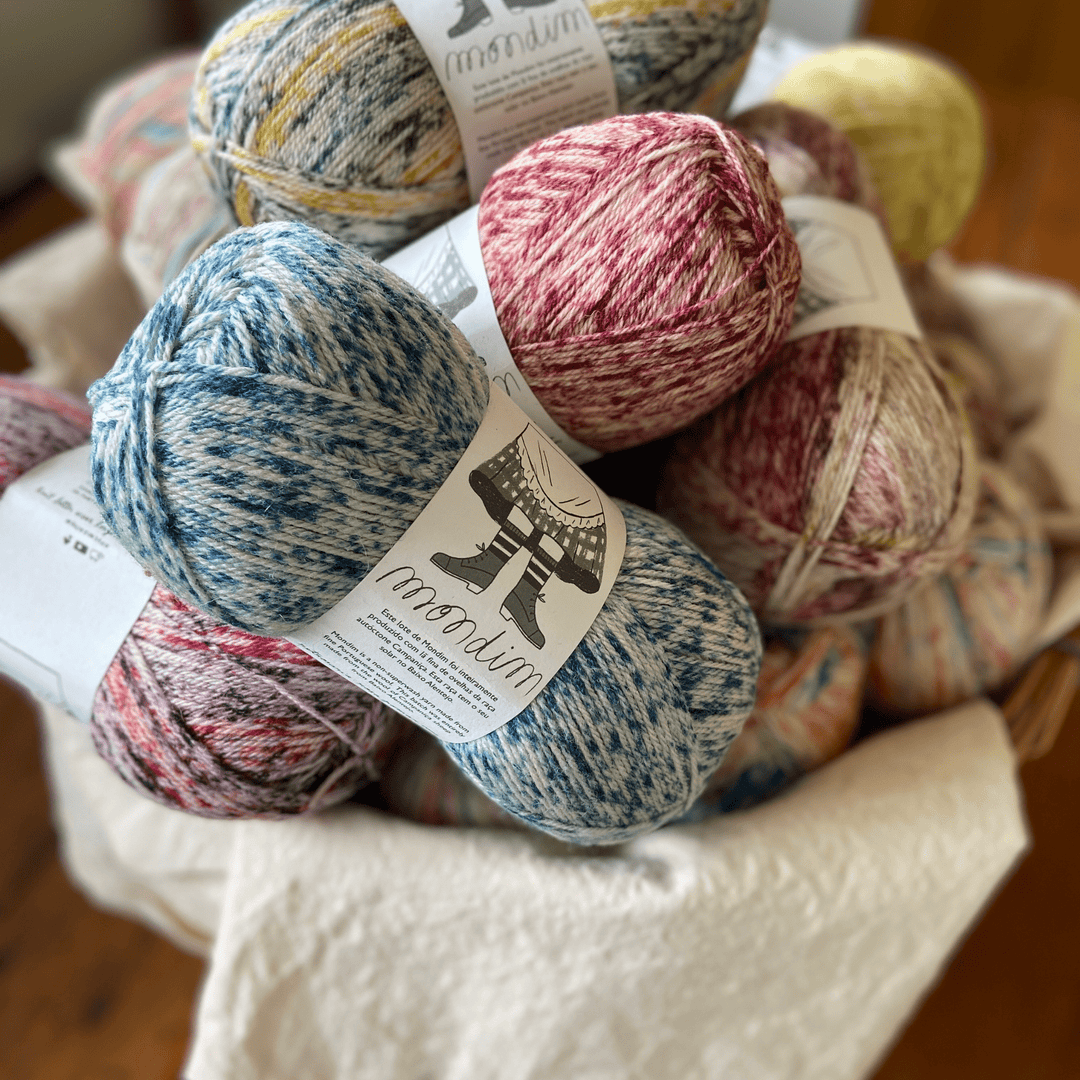
A pair of socks designed by Jessica McDonald in Retrosaria's fingering-weight Mondim yarn, spun from Campaniça wool. The pattern blooms across the leg like an Alentejo spring meadow. A natural pairing of yarn and design, both rooted in the same southern Portuguese landscape.
Shop the Among the Wildflowers Kit (opens in new tab)

Joji Locatelli's beloved warm-weather sweater, knit in Retrosaria's recycled-wool-and-cotton blend. A pattern that has dressed thousands of summers, paired with the most sustainability-minded yarn on the peninsula.
Shop the Super Simple Summer Sweater Kit (opens in new tab)
A Look Back at the Journey

We started this Armchair Travels in a tile-roofed corner of Iberia, with the promise that Spain and Portugal were a fuller wool story than most knitters realize. Five stops later, we hope you agree.
We have walked the cañadas reales, the ninety-vara drovers' roads of the Spanish Mesta, where transhumant flocks have moved between mountain and lowland for nearly a thousand years. We have met the sheep behind the yarn we knit with: Merino in all its global glory, Manchega the milk-and-wool sheep of La Mancha, Campaniça and Saloia in the south of Portugal, Xalda surviving in the misty north of Spain, and the smaller, rarer breeds being pulled back from the edge. We have spent time with WoolDreamers and Retrosaria Rosa Pomar, two producers whose fair prices to shepherds and steady demand on small mills have given a generation of native fleece a reason to exist. And today we have met the knitters themselves, with their inherited technique, their spinning gatherings, their heritage cloth, and their growing designer community.
Iberia's wool story is still being written. Every skein of Manchelopis cast on, every Mondim sock knit on the train, every Brusca cardigan worn through a winter is a small contribution to a fiber economy that someone in Castilla-La Mancha or Lisbon decided was worth saving. The work being done now sits on top of hands that came before, and it carries forward only because new hands keep picking it up.
We hope yours will be among them.
Thank you for traveling with us!

Collect Your Spain & Portugal Patch! (opens in new tab)

7 comments
Back to The Woolly Thistle





I have really enjoyed both of these armchair series. So thoughtful and well executed I am eager to see what region will be covered next.
This series is amazing. Once again, I’ve been moved to tears as I finish the story. Thank you for your eloquence and your respect for the cultures that preserve these traditions.
Fabulous series- really appreciate the research and work to revive traditional Spanush and Portugese wools! Thank you!
Thank you so much for sharing these Armchair Travels. It was so interesting to learn about different cultures and how they work to sustain the wool and the craft..
These armchair travels are amazing! Thank you so much for this interesting and enjoyable information. Knowing the stories behind these countries and their textiles makes knitting each project truly special.
Leave a comment