




Exploring the 2026 Shetland Wool Week Annual
One of my favorite things about the Shetland Wool Week Annual is the way it opens a window onto Shetland alongside the knitting. Every year, it gives us another little window into Shetland, its wool, its knitters, its landscape, and the traditions that continue to inspire makers around the world.
This year’s Annual brings the landscape and rhythms of Shetland right into the structure of the collection through the four seasons of Shetland:
- Hairst, Autumn
- Yöl, Winter
- Voar, Spring
- Simmer, Summer
I absolutely love this idea!
When we think about Shetland knitting, it can be easy to focus on the finished object, the beautiful Fair Isle motifs, intricate lace, or wonderful special Shetland yarns. But those traditions have always been shaped by life in the islands, where shifts in light, weather, color, and the work of each season form the backdrop to making, and the knitting changes with it.
Organizing this year’s Annual around the seasons allows the collection to travel through a full year of Shetland life.
And, of course, I immediately started thinking about yarn. One of the best parts of getting a new Shetland Wool Week Annual is sitting down with the patterns, digging through colors, and deciding what I would knit. So I thought we could take a closer look at some of the patterns in this year’s Annual, what caught my eye, and the yarns you can find at The Woolly Thistle to knit them.

Shop the 2026 Annual (opens in new tab)
Haust Glivs by Emily Poleson

Let’s start with some glorious color!
Emily Poleson’s Haust Glivs are a wonderful example of just how much you can learn about putting together a Fair Isle palette from one relatively small project.
The original gloves use Jamieson’s of Shetland Spindrift, but because Spindrift and Jamieson & Smith 2ply Jumper Weight work beautifully for the same types of traditional Shetland colorwork, you can easily create a J&S version.
Here are the substitutions I would use:
| Color | Jamieson’s Spindrift | J&S 2ply Jumper Weight |
|---|---|---|
| A | 120 Eesit/White | 202 Light Fawn |
| B | 231 Bracken | FC12 Grass Green |
| C | 578 Rust | FC38 Orange Rust Mix |
| D | 190 Tundra | 4 Moorit |
| E | 1200 Nutmeg | FC7 Salmon Orange Marl |
| F | 230 Yellow Ochre | 28 Mustard Yellow |
| G | 525 Crimson | 1403 Red |
| H | 423 Burnt Ochre | FC45 Tan |
| I | 140 Rye | 1A Natural White |
What I really like about this pattern is the way Emily approaches her palettes.
For the seven-color version, she starts with a light background for the main glove and builds the colorwork around a three-color fade, a light and dark shade from another color family, and a contrasting “singing” color through the center.
But here is the clever bit: that singing color belongs to the same family as the three-color fade, which helps pull the whole palette together.
Those same colors are useful again in the five-color version. This version is also a great lesson in working with a darker main color. Instead of asking all of the motif colors to fight against that dark background, Emily introduces a lighter background specifically within the colorwork. Suddenly the motif is crisp and easy to see.
She again uses a three-color family fade, but this time the main glove color becomes that center singing line, tying the colorwork back into the rest of the glove. There is so much color theory packed into a pair of gloves!
Shop Shetland Wool (opens in new tab)
Shaded Diamond Socks by Lesley Smith

These might be one of those rare patterns where I don’t immediately start swapping colors around.
The Shaded Diamond Socks are lovely just as they are, and since we carry all of the shades of Shetland 5ply used in the pattern, they are also a great excuse to try this traditional yarn.
Maggie thinks Shetland 5ply would make a wonderfully durable sock yarn, and I agree. This feels like exactly the sort of project where the yarn and pattern belong together.
The pattern includes two sizes, with finished foot circumferences of approximately 23 cm / 9 inches and 25 cm / 9.9 inches.
For the original palette you’ll need:
- Scarlet Twilight: 1 (2) balls, depending on size
Plus 1 ball each of:
- Maroon
- Aubergine
- Marine
- Turquoise
- Mustard
- White
I love the jewel-like progression of colors in these. The diamonds give you plenty of colorwork to keep the knitting interesting while still creating a sock that feels very traditional and very Shetland.
Vetch Jumper by Mandy Moore

This one is going in my queue! The Vetch Jumper is a beautiful bottom-up jumper with a Shetland lace yoke, and Mandy chose a wonderfully fresh, spring-like palette of Spindrift.
I think this is such a wearable sweater. I would also love to see it transformed for another season. Imagine it in a more neutral main color with a handful of heathery autumn shades worked through the yoke. Gorgeous!
If you’re having trouble finding the original Spindrift colors, you can easily dip into the J&S 2ply Jumper Weight palette instead.
Here are the substitutions I would make:
| Jamieson’s Spindrift | J&S 2ply Jumper Weight |
|---|---|
| 259 Leprechaun | FC11 Bright Grass Green |
| 462 Ginger | 125 Orange |
| 478 Amber | 32 Bright Tan |
| 182 Buttercup | 121 Marled Yellow |
| 179 Buttermilk | 96 Pale Lemon |
I love seeing traditional Shetland techniques used in sweaters that feel this easy to put into your everyday wardrobe. The lace keeps the knitting engaging while adding detail that still feels easy to wear.
Shop Shetland Wool (opens in new tab)
Da Hömin Tunic by Elizabeth Johnston

Da Hömin takes its name from the Shetland word for “twilight,” which already makes me want to cast one on. This all-over lace tunic is such a wonderful blend of traditional Shetland lace and modern sweater construction. There is also a lot of interesting knitting packed into this project.
You begin by knitting lace in the round from the bottom up, then transition to flat lace knitting when the body is divided for the armholes. The sleeves are worked separately in the round, which makes them wonderfully portable little projects, and then they are grafted into the armholes. You get to practice quite a few skills by the time this one is finished!
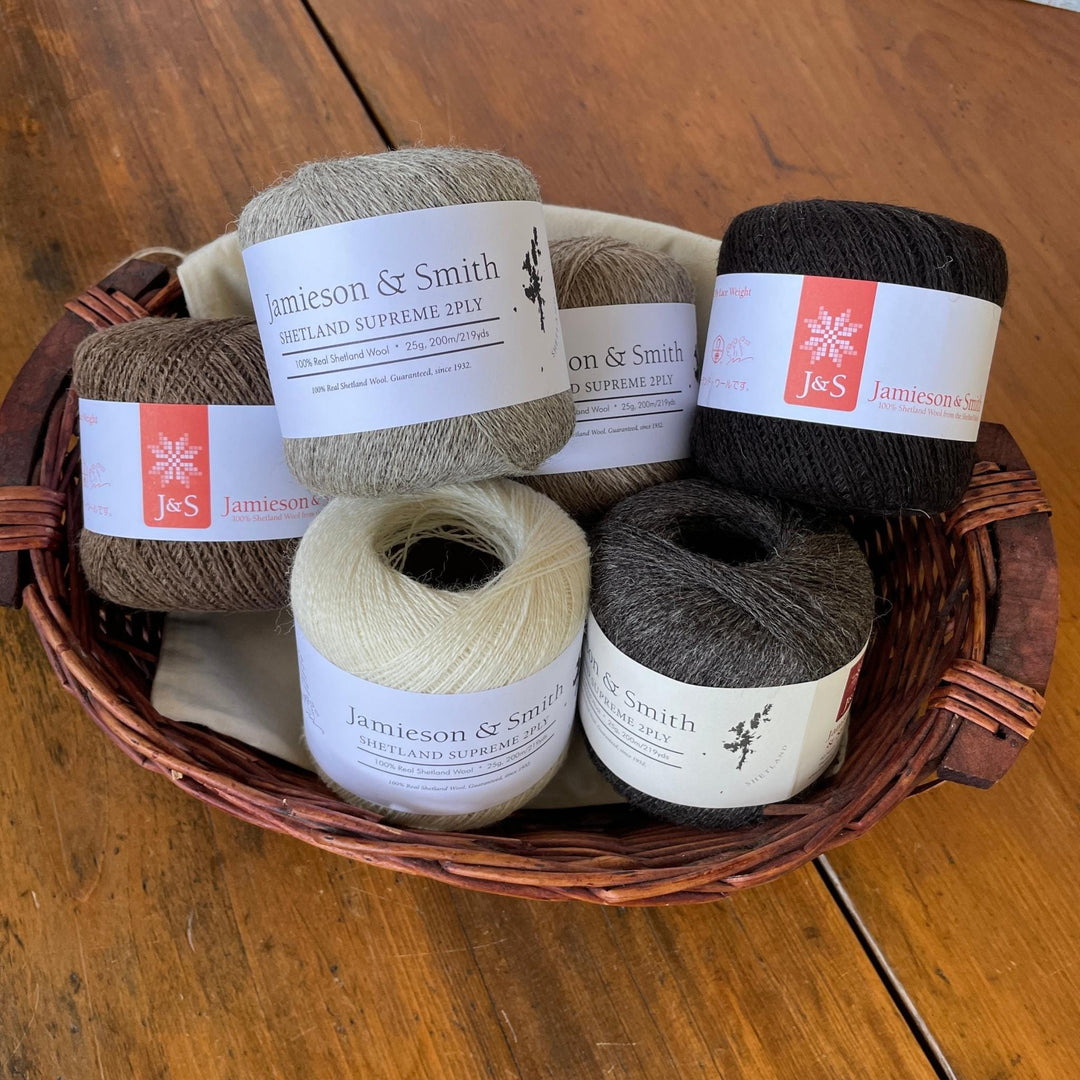
The pattern calls for either Spindrift or J&S 2ply Jumper Weight, but looking at the total yardage, I would go straight for a cone of J&S 2ply Jumper Weight. Even the largest size can be knit from a single cone.
We always talk about cones being wonderful because you have fewer ends to weave in, but I will admit that I sometimes find them a little clunky to cart around. My solution is to wind off a nice big ball, usually around 100 grams or so, and take that with me.
You still get all the benefits of fewer ends to weave in from having the cone without feeling quite so cone-bound while you knit!

Shop J&S Cones (opens in new tab)
Quenta Cowl by Ella Gordon

Ella Gordon is one of the few designers I have followed for years whose suggested colors I almost never want to change.
Her grasp of the J&S palette and her ability to translate those colors into beautiful knitted fabric is unparalleled.
The Quenta Cowl is particularly interesting because Ella uses the project to teach us about color dominance and the role it plays in Fair Isle knitting.
That makes this a really approachable project if you’re newer to Fair Isle knitting and want to understand more about how your hands and yarn placement affect the finished fabric. But even if this is your millionth colorwork project, there is still something to learn here.
And Ella has helpfully given us two palettes to choose from.
Colourway 1
- Yarn A: Brown (FC68), 3 balls
- Yarn B: Dark Red (9113), 1 ball
- Yarn C: Orangey Red (9097), 1 ball
- Yarn D: Light Blue (14), 1 ball
- Yarn E: Sky Blue (FC15), 1 ball
- Yarn F: Gold (28), 1 ball
Total: 8 balls
Colourway 2
- Yarn A: Grey (54), 3 balls
- Yarn B: Green (FC24), 1 ball
- Yarn C: Lime (9), 1 ball
- Yarn D: Orange (73), 1 ball
- Yarn E: Peach (90), 1 ball
- Yarn F: Lavender (49), 1 ball
Total: 8 balls
This is exactly the kind of project I love because you finish with something beautiful and useful, but you’ve also added another bit of knowledge to your knitting toolbox along the way.
Birsie Beanny by Helen Robertson

Of course, we can’t talk about the Shetland Wool Week Annual without talking about the official Wool Week hat!
This year we have Helen Robertson’s Birsie Beanny.
I love that these yearly hats have become little markers of time in the knitting world. Each year introduces us to another design, another palette, and often another Shetland designer. Knit enough of them and you almost have a woolly timeline of Shetland Wool Weeks gone by.
I wrote more about the Birsie Beanny earlier this year, including my thoughts on choosing colors, so rather than repeat myself here, you can pop over to my earlier Birsie Beanny article (opens in new tab) for a deeper dive.
And if choosing all those colors yourself feels like too much fun before you’ve had your tea, we also have Birsie Beanny kits ready to get you knitting.
Shop Birsie Beanny Kits (opens in new tab)
Bakka Beanie by Annie Garrick of the Shetland Peerie Makkers

Last, but certainly not least, is a pattern that I think makes this Annual particularly special.
The Bakka Beanie was designed by Annie Garrick, who at just 10 years old is already part of Shetland’s knitting story.
Annie participates in the Shetland Peerie Makkers, a wonderful program that teaches knitting to Shetland school children and helps ensure that the skills, traditions, and techniques unique to the islands continue to be passed from one generation to the next.
There is something very fitting about seeing her pattern alongside those of established designers in the Wool Week Annual. Shetland knitting traditions have survived because people continue to teach them, learn them, use them, and make them their own. Here we get to see that happening right in front of us.
Bakka is knit using Jamieson’s of Shetland DK, which we carry here at The Woolly Thistle, and the shopping list couldn’t be easier. You need 5 balls of Jamieson’s DK in colors that make you smile, that’s it! Pick your colors and you’re off making this delightful hat.

Shop Jamieson’s DK (opens in new tab)
A Year in Shetland Wool
I think that’s ultimately what I love so much about the four-season theme of this year’s Annual.
Hairst. Yöl. Voar. Simmer.
Autumn becomes winter. Winter eventually gives way to spring. Spring turns into summer, and before we know it, we’re back at autumn again.
Knitting has its own seasons too. There are the big projects we settle into when the weather turns cold, the portable projects that travel with us through summer, the burst of color we crave in spring, and those first gloriously woolly cast-ons when autumn comes around again.
The Shetland Wool Week Annual always celebrates Shetland knitting, but this year it also celebrates the place, rhythm, and natural colors found all around the islands that those knitting traditions grew from.
And perhaps my favorite thing about this collection is the range of knitters represented within it. We have traditional lace, Fair Isle, socks, gloves, sweaters, a lesson in yarn dominance contained in a cowl, the annual Wool Week hat, and even a design from a 10-year-old Peerie Makker learning and carrying these traditions forward.
That feels like Shetland knitting to me. Traditions are preserved by continuing to knit them. Now the only problem is deciding what to cast on first… I’m looking at you, Vetch Jumper.

1 comment
Back to The Woolly Thistle


Great presentation Cait. I love shetland knitting and the Beanies year after year are the best.
Leave a comment