


Armchair Travels: Shetland - Meet the Sheep
The creature at the heart of Shetland’s wool story is small, nimble, and covered head to hoof in some of the most sought-after wool in the world. We have wandered the islands and shared in their great autumn gathering, and now we arrive at the animal behind all of it: the Shetland sheep. Sturdy enough to shrug off a North Atlantic gale and endearing enough to win over anyone who meets one, this extraordinary wee breed is the reason a far-flung handful of islands became a name spoken with reverence in knitting circles the world over. Let us make its acquaintance.
A Thousand Years in the Making

The Shetland is one of Britain's oldest and smallest native breeds, and its history is bound up with the same seafaring settlers we met earlier in our travels. More than a thousand years ago, Norse voyagers carried their sheep across the water, and those animals became the ancestors of the flocks that graze the islands today. They belong to a hardy northern family known as the short-tailed sheep, cousins to the Icelandic and the Norwegian Spælsau, and generations of island life shaped them into exactly what these conditions demanded: a compact, thrifty, sure-footed animal that could thrive on exposed hills and a spare diet where larger breeds would struggle.
 |
 |
 |
Their modest size was an advantage on Shetland’s rough ground, yet it worked against them in a changing agricultural market. They are small and slow to grow, giving less meat and a lighter fleece than the big commercial breeds that spread across Britain, and as farmers turned to those larger sheep, Shetland numbers fell away. Efforts to crossbreed them for greater size and yield only thinned the pure breed further, until, by the time the Rare Breeds Survival Trust was founded in the 1970s, the Shetland was classed as endangered.

Happily, a devoted community of crofters and smallholders brought it back from the brink, and today the Shetland is no longer considered at risk. The islanders had seen the danger coming long before: back in 1927 they formed the Shetland Flock Book Society to guard the breed's character against dilution, and it watches over the sheep to this day. In 2011, the wool itself received a rare honor, becoming the first non-food product in the United Kingdom to earn protected status tied to its place of origin. Not bad for a humble island sheep, and one with a surprising fan club: even Thomas Jefferson is said to have kept a Shetland ram at Monticello in the early 1800s.
The Finest of Fleeces

The same island conditions that shaped the Shetland into such a hardy little sheep also shaped its greatest treasure: its fleece. Shetland wool is spun from one of the softest fleeces of any British breed. Its finest fibers, grown at the neck and shoulders, measure only in the low twenties of microns, soft enough to sit happily against the skin. What sets the wool apart is its crimp: a fine, folded wave along each fiber that gives the yarn a lofty, springy character and a warmth far greater than the weight would suggest. This is wool with backbone and bounce in equal measure.

That combination makes Shetland astonishingly versatile. The very finest can be knitted into gossamer lace so delicate that a full-sized shawl will pass clean through a wedding ring, an old island test of a knitter's skill. The sturdier wool from the same animal becomes hard-wearing tweed and the crisp, toothy yarns beloved for Fair Isle colorwork. One breed, one fleece, and a range that stretches from the airiest lace to a coat for the wildest of days.
Every Shade Under the Northern Sky

Shetland’s remarkable range of color begins long before the wool ever reaches a dye pot. Shetland sheep grow their wool in one of the widest natural color ranges of any breed on earth: eleven main shades and some thirty distinct markings, most still known by the old Shetland dialect names handed down from the islands' Norse-speaking past. There is moorit, a warm reddish brown; shaela, a dark steely gray likened to black frost; mioget, the color of pale honey; and emsket, a dusky blue gray you would swear was borrowed from the winter sea. The markings carry the finest names of all. A katmoget sheep wears a pale coat with a dark belly and a bandit's mask across its eyes, while its mirror image, the gulmoget, is dark of body with a light underside.

For centuries these shades let island knitters build richly colored patterns without dyeing a single strand. It is a fragile inheritance, though. Plain white wool has long fetched the better price, so many of the rarer colors have grown scarce, and keeping them alive now falls to the shepherds who prize them.
The Ancient Art of Rooing
One last island tradition deserves a mention, because it is older than the shears themselves. Many Shetlands do something most modern sheep have long forgotten how to do: they shed their own fleece. Each spring, as the new coat begins to grow, a natural break forms in the fibers, known on the islands as the rise. When it appears, the old fleece can simply be plucked away by hand, a gentle practice called rooing. It does not hurt the animal in the least, and it leaves behind a clean fleece with no clipped ends, ready for the spinner. Photographs in the Shetland Museum show islanders rooing their flocks generations ago, exactly as a few still do today.

By the time a fleece reaches the yarn we knit with, careful human hands have sorted it too. At the wool brokers in Lerwick, graders work through each fleece by touch and eye, separating the finest wool from the coarser, a craft we will return to when we meet the makers. For now, it is enough to know that behind every ball of true Shetland wool stands a hardy little sheep, a windswept hillside, and a great deal of care.
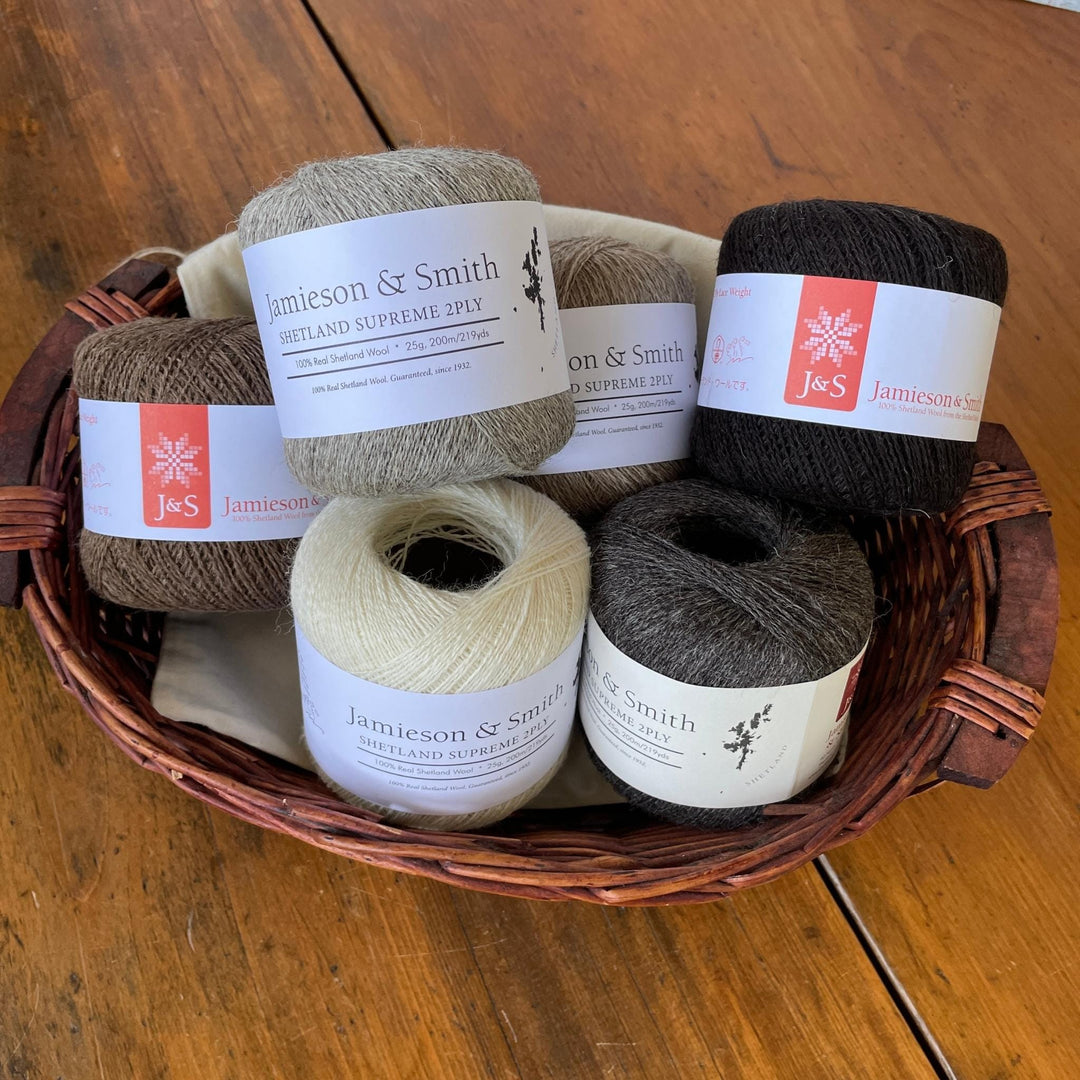
You can still knit with the fleece of this ancient island breed today. Jamieson’s of Shetland and Jamieson & Smith both offer 100% Shetland wool yarns, carrying the sheep’s natural warmth, bounce, and character into modern knitting.
These are yarns closely tied to the traditions we are about to explore, especially the crisp colorwork of Fair Isle. We will delve into the makers themselves in the near future!
 |
 |
Where the Wool Begins
So the next time you cast on with Shetland wool and feel that gentle spring between your fingers, you will know the long road it has traveled to reach you: a thousand years of island weather, a breed saved by the people who love it, and a fleece grown in colors no dye could match. You will find plenty of it waiting on our shelves, spun from these very sheep. Next time we follow that wool onto the needles at last, into the two traditions that made these islands famous: the bold geometry of Fair Isle and the breathtaking delicacy of Shetland lace.
3 comments
Back to The Woolly Thistle


I am in love with this little sheep! I find this particular breed, Shetland, most endearing. I also am amazed by the natural colors. It’s inspiring me to design something using the natural colors, This journey of all three, all excellent, has moved me the most. Thank you for sharing the knowledge and teaching me a deeper understanding of the wool in my hands. I am currently knitting a sweater with Shetland wool. J&S
I just love all the information you provided about the sheep, wool and how they were raised.
I also loved the first two. Can’t wait for the next one.
Thank you for this opportunity to learn so much about Shetland sheep. They are amazing wee creatures!
Leave a comment